Interviewing watercolour master Jung Hunsung
Today we present you Jung Hunsung, an artist who uses watercolour to explore and primarily portray the human figure. His work stands out for its sensitivity, delicacy, and emotion, capturing each portrait and transforming every painting into an expression filled with feeling.
In this interview, he talks about his approach to art, his creative process, and his relationship with watercolour and Escoda.
Today, your work inspires thousands of artists around the world. When did you first discover watercolour, and when did you decide it was the artistic path you wanted to follow?
I first discovered watercolor when I was very young. Life was not always abundant or easy, and painting became a quiet place of comfort and expression for me. Among all artistic mediums, watercolor felt different from the very beginning. There was something alive in the way water and pigments moved across the paper—sometimes revealing beauty beyond what I had imagined.
If I am asked when I decided watercolor would become my path, I cannot point to a single moment. Rather, watercolor gently led me here over time. Through years of conversation with water and color, it gradually became more than a profession or a technique. It became a way of understanding both the world and myself. Even today, I continue to learn about life, art, and who I am through painting.
Watercolour is often considered a difficult technique to master due to the level of control required over water and its unpredictability. What do you think makes it special compared to other techniques?
Many people describe watercolor as a difficult medium because it cannot be completely controlled. Ironically, I believe that is precisely what makes it so extraordinary.
We cannot fully control water. Sometimes we guide it, and sometimes we simply follow where it wishes to go. To me, watercolor is not about control—it is about dialogue. It teaches us patience, humility, and acceptance.
Watercolour is also one of the purest forms of artistic expression. Water, pigment, and paper—nothing more is needed. Yet within these simple elements lies infinite possibility. The moment where intention and chance coexist is what makes watercolor endlessly fascinating to me.
After so many years in your artistic career, what still excites you about painting, and what do you feel when you’re in front of a blank sheet of paper?
Even today, a blank sheet of paper fills me with excitement. I do not see it as emptiness—I see it as endless possibility.
After many years of painting, I am no longer pursuing perfection. What excites me most is discovery. Every painting asks me a new question, and I continue my journey in search of its answer.
Standing before a blank sheet of paper feels very much like standing before the sea. I do not know exactly what awaits me beneath its surface, but I know there will always be new landscapes and emotions waiting to be discovered. That is why the beginning of every painting remains the most exciting and joyful moment for me.
Throughout your career as an artist, what have been the most challenging obstacles and the most rewarding projects you’ve worked on?
The greatest challenge has never been technical—it has been remaining true to myself as an artist. Continuing to paint with sincerity while preserving one’s own voice amidst changing trends, expectations, and uncertainties requires both courage and patience.
On the other hand, the most rewarding moments of my career have not been exhibitions or awards. They have been the moments when someone tells me that my paintings brought them comfort, or when a student shares that watercolor has changed the way they see the world.
Having the opportunity to paint alongside artists from different countries and share not only techniques but also our stories and lives has been one of the greatest gifts of my artistic journey.
To achieve the realism, purity, and emotion present in your artwork, do you think it’s important to work with high-quality materials?
I do not believe that great materials alone can create a great painting. However, I do believe that they allow artists to express their emotions and ideas with honesty and fidelity.
Artists spend years cultivating their own sensitivity and artistic language. The tools we use should never become obstacles—they should serve as a bridge between our intentions and the paper.
Watercolour, in particular, is an art of water, pigment, and time. High-quality materials provide us with confidence, consistency, and freedom. Only then can we stop thinking about our tools and focus entirely on the act of painting itself.
We’ve recently collaborated on the development of two artist brush sets. What motivated you to get involved in this project?
For me, this project was never simply about creating new brushes. It was about creating tools that could faithfully express what artists wish to say through their paintings.
Throughout many years of teaching, I have met countless artists who struggled not because of a lack of skill, but because their tools could not naturally support their artistic intentions. I have always believed that a brush should become a natural extension of the artist’s hand.
What impressed me most throughout this collaboration with Escoda was their passion, craftsmanship, and genuine desire to create something meaningful. Together, we were not asking, “How can we make another brush?” Rather, we were asking, “How can we help artists express watercolor more freely and more beautifully?” That question became the very reason I wanted to be part of this project.
Discover Jung Hunsung’s two artist sets below:
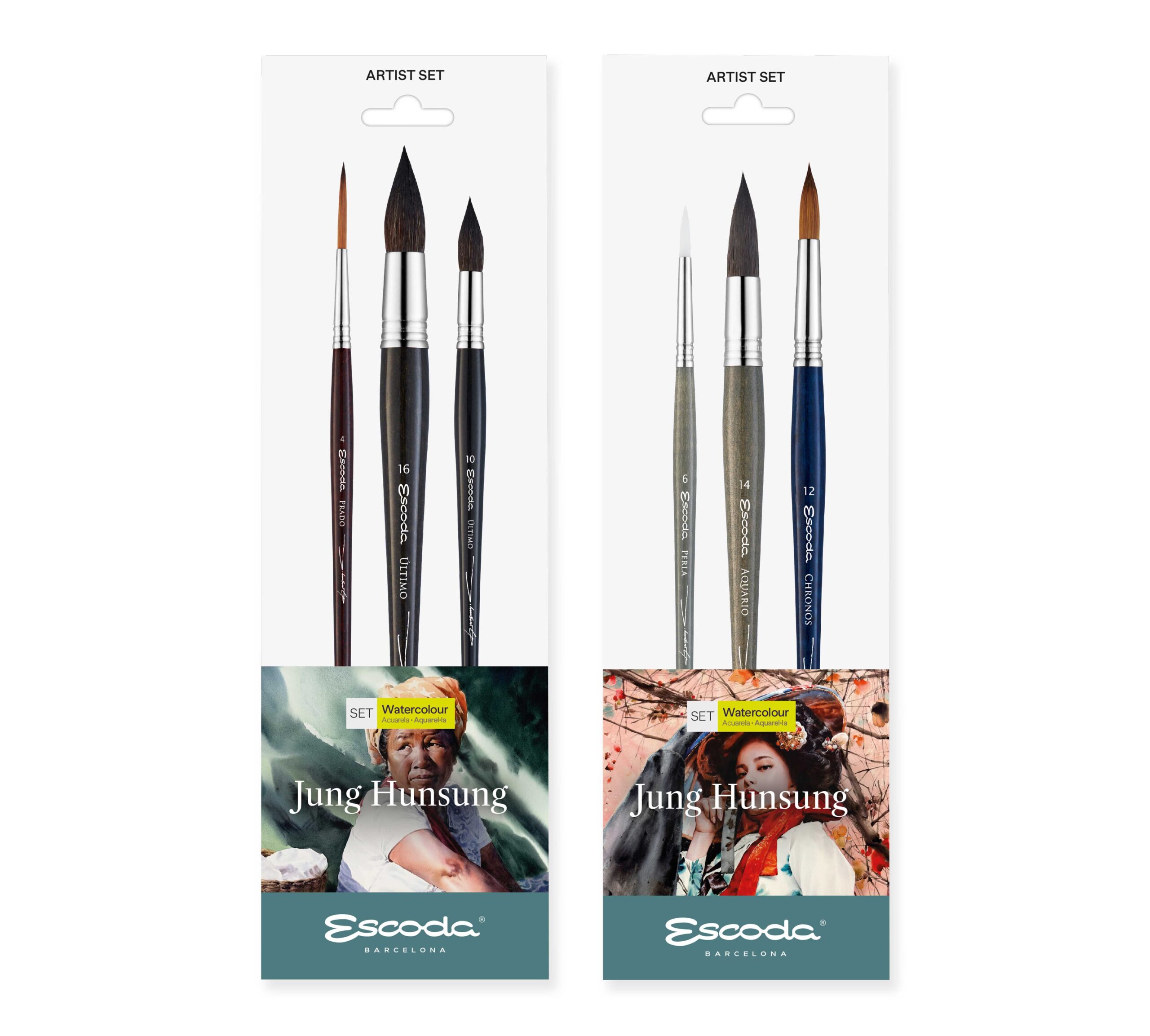
For artists who are considering trying the brushes included in these two sets, why and how can they help improve their watercolor experience?
I believe a brush should quietly disappear while we paint. When artists are no longer conscious of their tools, they can devote themselves entirely to the joy of creating.
These brush sets were thoughtfully designed to hold water generously, respond naturally to subtle movements, and offer the freedom to move effortlessly between broad washes and delicate details.
Of course, no brush alone can make someone a great artist. However, the right tool can remove unnecessary limitations and allow artists to discover more of their own voice and expression.
My hope is that these brushes will become trusted companions throughout each artist’s creative journey. Watercolor is not an art of controlling everything—it is a journey of discovering unexpected beauty between water, pigment, paper, and ourselves. If these brushes can make that journey a little more joyful and a little more free, I would consider this project truly meaningful.
Beyond the brushstroke
It has been a pleasure to get a little closer to Jung Hunsung’s world and discover, through his words and his journey, his passion for watercolour and his unique way of seeing the world. We sincerely thank him for sharing his experience and artistic sensitivity with us. We hope you have enjoyed this conversation as much as we have, and that it has allowed you to get to know a little more about the person behind every brushstroke.
You may also be interested
